Last week, I spent a morning at the corrals, pushing calves through a cute. The last time I’d had a ranchwork day, it had been a crisp, fall day and the season had felt vibrant, but this morning, nearly a month later, the season had faded to gray. Out in the brisk wind, the generator humming so loud, we could only communicate in shouts, and so, mostly, I was in my own world. It was slightly monotonous job, walking up and down the chute, keeping calves moving, and, as always, my mind began to wander to strange and unsuspecting places.

With clouds building up in the sky, threatening snow, and the last few dead leaves still clinging to the trees, I was thinking how seasons in Wyoming begin in vibrant color and devolve into grays and browns. It wasn’t a sad musing, just a thought that, yes, this is how the world works.
A few weeks ago, I was reveling in fall’s yellows, reds and oranges, taking advantage of clear weather to get out and walk in it every chance I got. Those colors have all faded and, with the recent time change, there’s a darkness to the season. Winter will start soon, and I always look forward to those early snows that bring a crisp lightness, with the light yellow tips of sun-dried grass sticking up above the sparkling white.
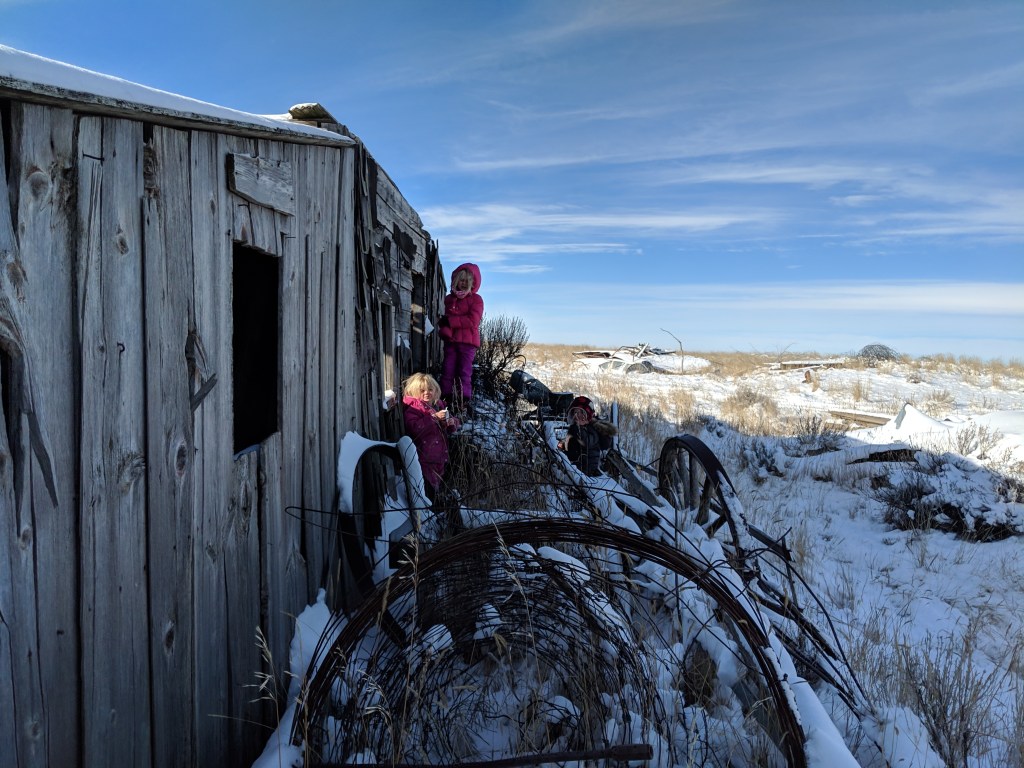
That winter enchantment doesn’t last long, and sometime in January, when those fresh white snows are now a windblown across the prairie or a slushy mess on the road, I’m cranky and ready for the whole season to be over. Spring breaks the pattern, beginning with winter’s greys and browns, but eventually erupting in green grass and wildflowers.
I always say I love summer, but really it’s only the first bit that still holds spring’s colors. By summer’s end, pastures are sun-bleached, fires around the state have turned the sky to a haze, and the dried grass crunching under foot serves as a reminder that we are in high fire danger ourselves.
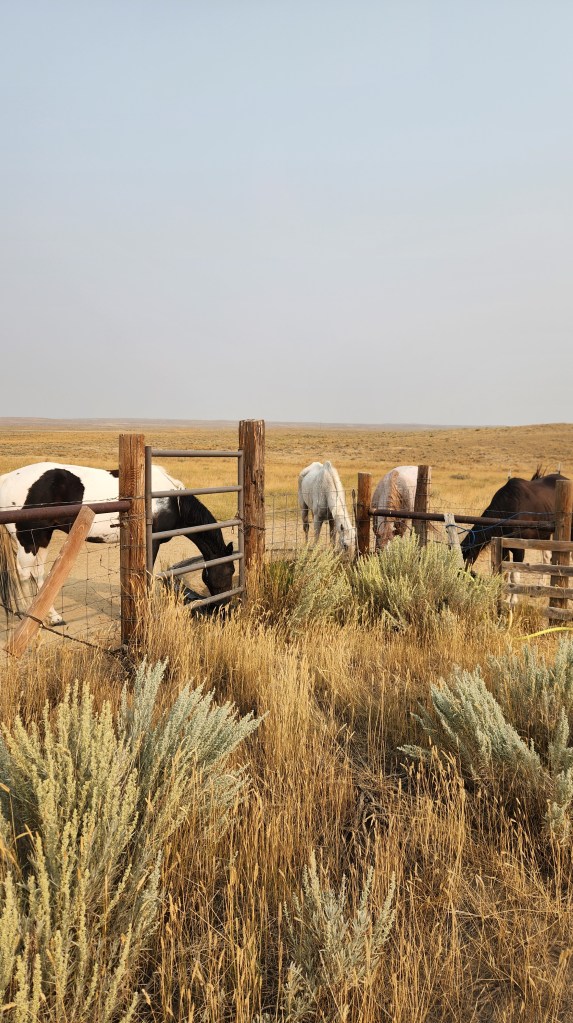
On a hot August day, I’d found a few thirsty horses standing around a bone dry trough. I ran the water for them, and tried to capture this end-of-summer feeling in a photo. I never posted it because there in the center was Kem’s old gray horse, with his bony spine and ribs you can count. The last time the equine dentist had been out to fix his teeth, she’d said he would eventually outlive them, and his emaciated figure in the picture is a reminder that the time had come. He was at the end of his life and there was nothing we could do about it.
He’d always been hot-blooded. In the first several years, before Kem could even ride him, he’d have to lunge the horse to burn off his excess energy. One day, just after he came to our place almost eighteen years ago, I sat on the fence and watched Kem work this light gray speckled horse, whose name he hadn’t yet settled on.
When they’d finished their training session, Kem turned him out to pasture, and, watching him gallop off into the pasture, tail high, he’d said, “If there was ever a horse that should be named Snowflake, this is it.”
He’d wanted another name to stick, anything so it didn’t sound like twelve-year-old girl’s horse. But Snowflake it was, or sometimes Twinkle Toes, for all the prancing he did when Kem forced him to move at anything slower than a full gallop.

That I’m eulogizing a horse says something about the horse. I’m not a horse person. My main interaction with them is chasing them off the front porch when they’re eating my flowers. I tried to become a rider only to discover that I’d rather not.
One day, Kem had come home from a gather and said, “When I tried to slow down my stupid horse, he’d run sideways, so I made him go the whole way sideways.”
That does not sound fun to me.
Horses seem like more trouble than they’re worth, and yet, there have been a few that I have grudgingly loved. There was a bay I used to ride because he had a soft spot for green riders and wouldn’t give them any trouble. I named him Valentino. Then there was another bay, named Big Jon, after the man who rode him.
Big Jon was another hot blooded horse, who outlived his teeth, and one fall, when we could count all his ribs, it was clear he wouldn’t last the winter. In his last few days before the vet came out, I’d hug him every time I’d go outside. He was probably very confused as to why the lady who was usually yelling at him was now loving on him.
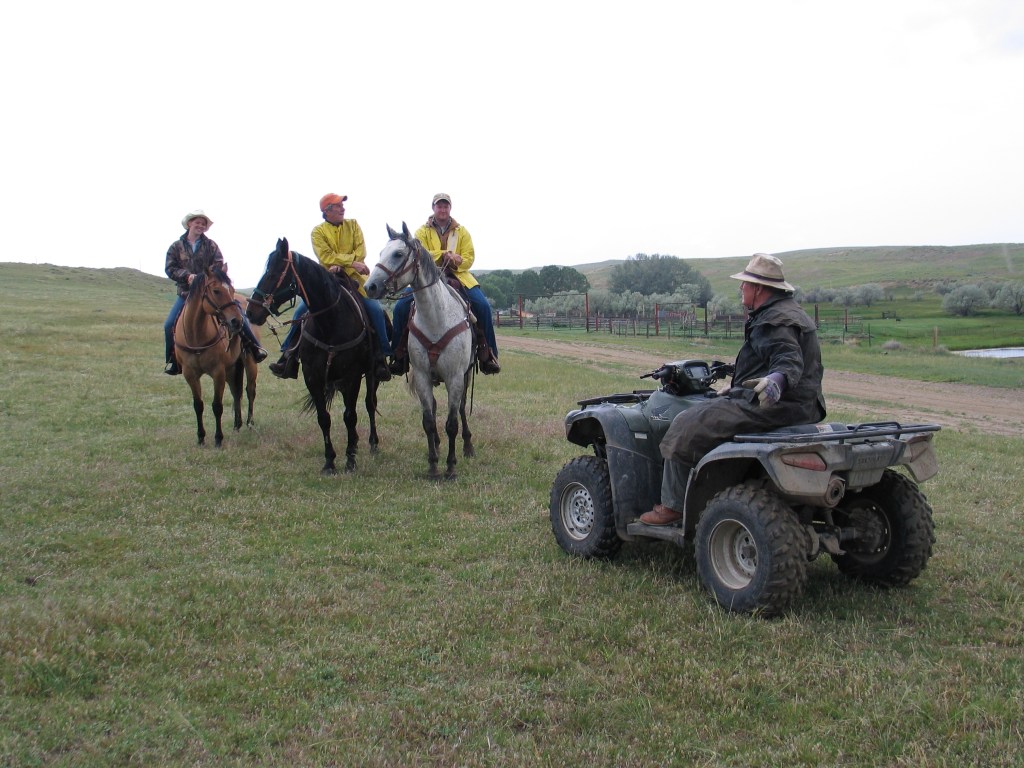
In the photo above, Jon is in the center on Big Jon and Kem is on Snowflake. My sister is on Obi Wan, my brother-in-law’s horse who lived a remarkably long time on bad teeth. He was a great kid-horse. Bob is on the four-wheeler, a more sensible mount, to my mind. I hadn’t given much thought when snapping the picture beyond just recording this gather on this day. Now, when Jon, Bob, and all three horses are no longer with us, the photo feels like it has some weight to it, like it’s some window into the truth about life.
This is how the world works. It sounds a lot more harsh when I say that about horses, and men, I’ve loved. Maybe there’s nothing more than a reminder of all of them when they were vital and full of life.
On a gray day in this gray season, the vet came to give this old gray horse a shot and spare him from the ravages of the upcoming winter. Kem buried him out in the pasture. By spring, he’ll be covered in green grass, but the Wyoming prairie is always going to return to gray.
 Vegetarian Ranchwife