My essay, Fimbulwinter, just came out in the latest issue of Wild Roof Journal, an essay dealing with last year’s apocalyptic winter. When the journal editors scheduled the it for their January issue, I thought, Perfect! We’ll have single digit temps, sub-zero if we’re lucky, and I’ll post the essay with a recent picture from feeding, our Wyoming winter hellscape on full display. I’ll make some clever quip about reading this winter essay next to the stove while my toes thaw out.
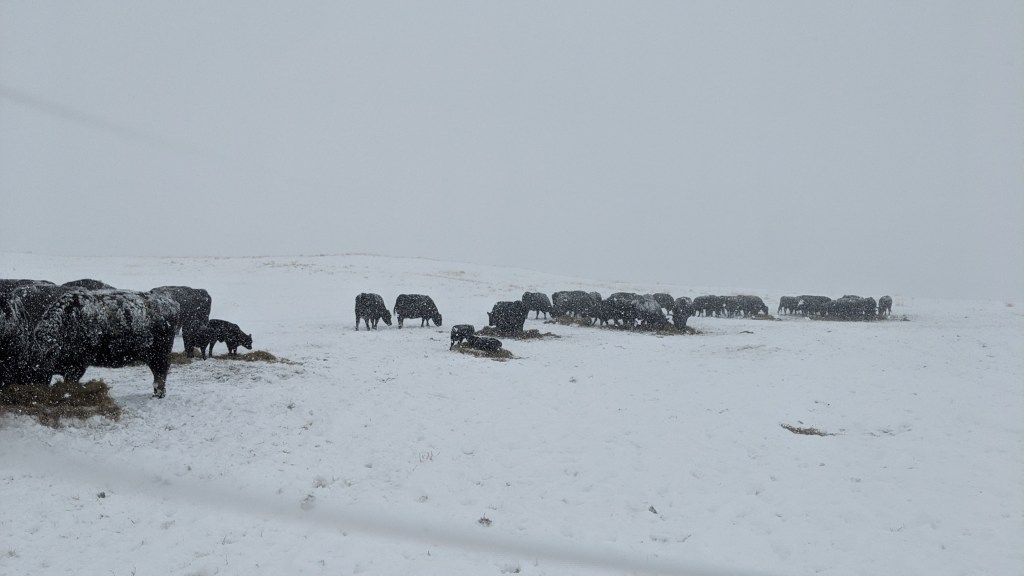
But because real life never works out the way I imagine, I’m reading this essay in what, so far, has been an exceptionally warm winter.
We had a bitter cold snap around Thanksgiving, with temperatures dropping below zero, and I thought, Here we go! I was ready to settle into my usual winter lamentations.
Chinook winds arrived a few days later, as expected, melting the snow. I braced myself for the next storm, the next cold snap. . .and I’m still waiting. We had a good portion of days in December getting up into the 40s, and January has continued the trend.

We could count this as a blessing. Kem hasn’t started to feed the cows yet—the latest, I think, in my eighteen winters here. We’re saving on hay, but, as an old ranch hand (God rest his soul) used to say, “A rancher can find the cloud in any silver lining.”
We spent New Year’s Eve with our neighbor, a climate researcher, and, over champagne and crème brulee, our conversation turned to speculation about drought.
The two constants for ranchers in the Rocky Mountain West are miserable winters and cyclical droughts. My father-in-law (God rest his soul) used to say that we could expect drought every seven years, which always felt biblical to me. But it was just something he planned for. Kem spends the good years drilling wells, leaving some pastures ungrazed so he has a grass-bank for the lean years. It’s the same way he prepares for winter, growing hay in summer, keeping equipment maintained for snow removal.
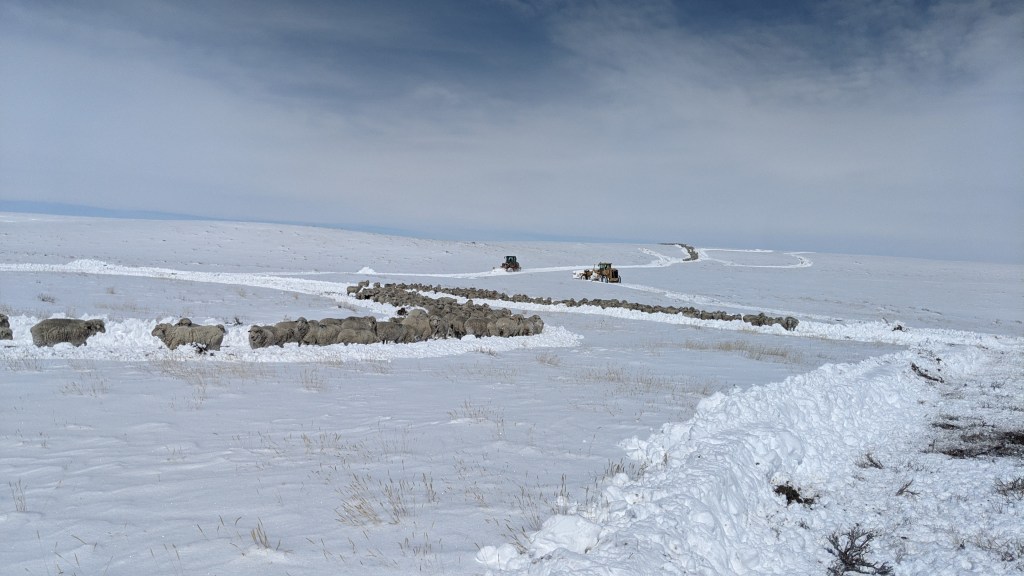
Climate change has thrown our usual weather patterns into flux. Last winter felt catastrophic. We made it through, but it was grueling. We couldn’t imagine dealing with anything worse, but we may have to. Our predictable seven-year drought rule of thumb isn’t going to hold, but who knows what our future droughts will look like? All of our systems are built in the expectation that the weather is going to keep on doing what it has always done, but it won’t. How do we handle that level of uncertainty?
At the end of summer, I had asked my neighbor what the predictions were for the upcoming winter and he hedged with all the appropriate caveats. I had already written the above essay, which is all about our inherent human need for predictions and the inability to accurately make them and still, when he answered, all I heard was, “Blah, blah, blah, more snow than usual.”
Even though it was bad news—maybe because it was bad news—I left that conversation with the smug reassurance that I knew what to expect. Now I’ve been gritting my teeth through these past few months of mild weather thinking, Just snow already! As if it’s a shot at the doctor’s office and I just want it over with.
Of course, we’ve still got several months of winter ahead of us. Who knows what it’s going to do? It’s either going to snow or it won’t. We’ll either have a drought or we won’t.
In his essay, “What Pastoralists Know,” Ian Scoones describes two fundamentally different approaches to dealing with uncertainty. There’s the banker/government model of making predictions and trying to control for each foreseeable disaster. The problem, of course, is that there will always be a disaster we could never have foreseen—Scoones wrote the article in the midst of the Covid-19 chaos. Pastoralists provide a model of a flexible and adaptive approach to uncertainty. Their methods rely on social networks, so when one group faces drought on their usual grazing lands, they might reach out to a neighboring group to share grazing land.
In other words, they get by with a little help from their friends.
In my writing, I keep circling back to the pastoralist lessons I’ve learned from living on a sheep and cattle ranch, and yet, I’m educated and embedded in this modern world run by models and control. I keep slipping back into those patterns. Lucky for me, real life will always hit me with another lesson on dealing with uncertainty.
 Vegetarian Ranchwife